Glass Filled Nylon 12 Powder (SLS)
A glass-filled, biocompatible SLS nylon with enhanced stiffness and heat resistance for demanding industrial environments. Nylon 12 GF holds shape at temperature where unfilled nylon softens, with no supports to remove.
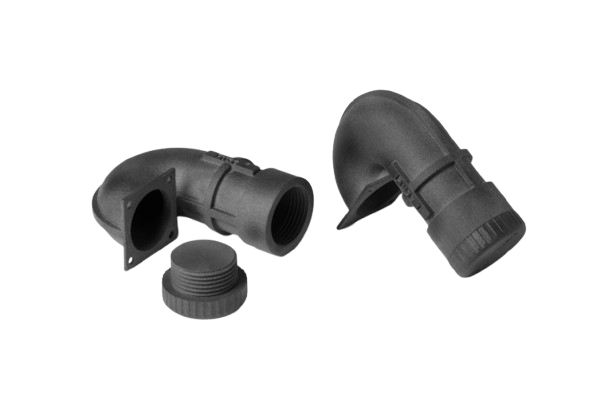
Real Nylon 12 GF SLS Parts
Actual Formlabs SLS prints in Glass Filled Nylon 12 Powder, not renders.

Summary & Key Takeaways
- Stiffest SLS Nylon We Print: A 2.8 GPa tensile modulus, roughly 1.5 times unfilled Nylon 12, from glass filling.
- 170 °C Heat Deflection: Nearly double Nylon 12's 87 °C, for parts that see sustained heat.
- Dimensionally Stable: Glass filling reduces warp and creep, so large flat parts and fixtures stay true.
- Stiffness Costs Ductility: 4% elongation at break; not for snap fits or parts that must flex.
Compare Nylon 12 GF SLS to Other 3D Printing Materials
A quick, scannable comparison against the alternatives engineers usually weigh against it. All values are shown at once; use the buttons to focus on one comparison at a time.
Swipe to see all materials →
| Property | Nylon 12 GF SLS | Nylon 12 SLS | Rigid 4000 | High Temp |
|---|---|---|---|---|
| Tensile modulus | 2.8 GPa | 1.9 GPa | 4.1 GPa | 2.8 GPa |
| Flexural strength | 56 MPa | 66 MPa | 69 MPa | 97 MPa |
| Elongation at break | 4% | 11% | 5.3% | 2% |
| Notched Izod impact | 36 J/m | 32 J/m | 23 J/m | 17 J/m |
| Heat deflection temp (0.45 MPa) | 170 °C | 87 °C | 77 °C | 238 °C |
| Support structures | None required | None required | Removable supports for overhangs | Removable supports for overhangs |
Why Choose Glass Filled Nylon 12 Powder (SLS)?
The stiff, heat-capable end of the SLS range, for structural parts that also need the geometric freedom of powder-bed printing.
Glass-Filled Stiffness
A 2.8 GPa tensile modulus and 56 MPa flexural strength let enclosures, brackets, and structural housings carry load with far less deflection than unfilled sintered nylon, closing much of the gap to a filled resin.
Holds Shape at Temperature
A 170 °C heat deflection temperature at 0.45 MPa, nearly double Nylon 12's, so fixtures and housings stay dimensionally stable in engine bays, near heaters, and through paint or cure cycles.
Complex Geometry, No Supports
Because parts are sintered in a powder bed, internal channels, ribbing, and threaded-insert bosses print without supports, and the finish is uniform on every face rather than scarred where supports attached.
Nylon 12 GF SLS Design Rules (DFM) at a Glance
Formlabs SLS design guidelines for the Fuse Series. Check your CAD feature dimensions against these limits before uploading your file.
| Min. wall thickness (vertical · horizontal) |
0.8 mm for both (same minimum whether the wall is supported or unsupported) |
|---|---|
| Min. pin/wire diameter | 0.8 mm |
| Min. hole diameter | 1.0 mm |
| Min. drain/escape hole (2 per powder-trapping cavity) | 3.5 mm |
| Clearance, mating features separated after printing | 0.2 mm (< 20 mm²) · 0.4 mm (> 20 mm²) |
| Clearance, mating features printed pre-assembled | 0.3 mm (< 20 mm²) · 0.6 mm (> 20 mm²) |
| Clearance between unrelated parts in a build | 1.0 mm min · 5.0 mm recommended |
| Min. embossed detail (raised text/logos) |
0.15 mm deep, horizontal face · 0.35 mm deep, vertical face (4.5 mm min. text height) |
| Min. engraved detail (recessed text/logos) |
0.1 mm deep, horizontal face · 0.15 mm deep, vertical face (3.0 mm min. text height) |
| Dimensional tolerance (XY) | ±0.5% or ±0.3 mm, whichever is larger |
| Max. single-part build size | 330 × 330 × 565 mm |
Source: Formlabs' Design specifications for 3D models: Fuse 1, adapted to hold walls to a higher minimum than Formlabs' published figures. Nylon 12 GF is glass filled and only 4% elongation at break, so thin walls and sharp internal corners crack more readily than in unfilled nylon; add fillets on load paths and keep handled features at or above the minimum wall. These are general guidelines; thicker cross-sections, hole depth, and part geometry can shift the safe minimums for a specific design. Maximum build size reflects our largest-format SLS printer; actual build size depends on which machine your order routes to. Dimensional tolerance is Formlabs' published typical XY tolerance for Fuse Series SLS, the widest figure across the SLS printers we run.
Frequently Asked Questions
Everything you need to know about designing, ordering, and using Nylon 12 GF SLS parts on Form Now.