3D Printing Materials, Compared
PLA vs PETG vs ABS, resin vs filament, SLA vs SLS — compare 26 materials and 3 processes head to head, find the right one for your part, then get it printed by Form Now.
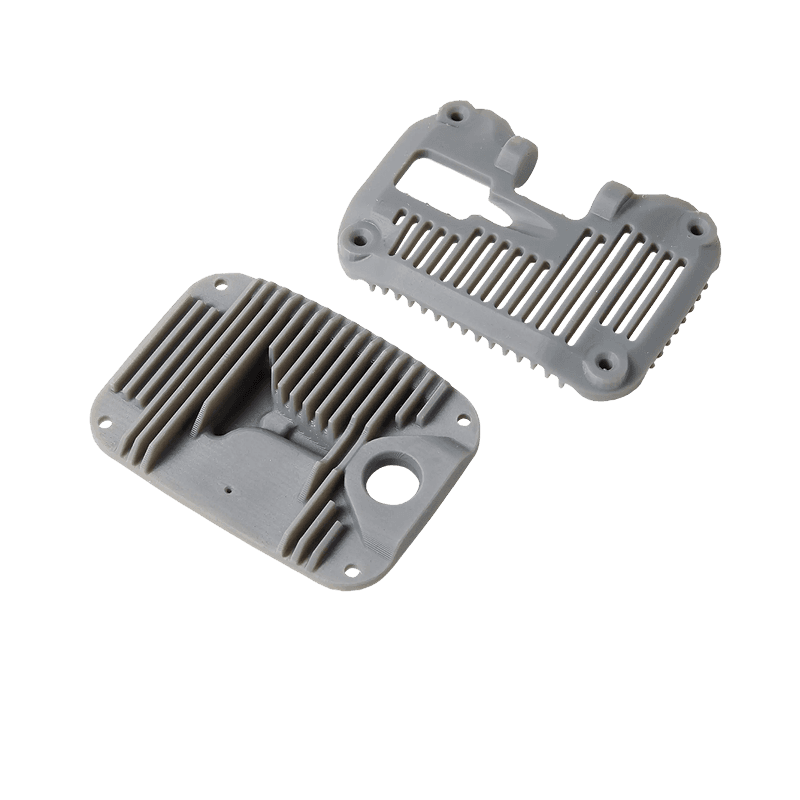
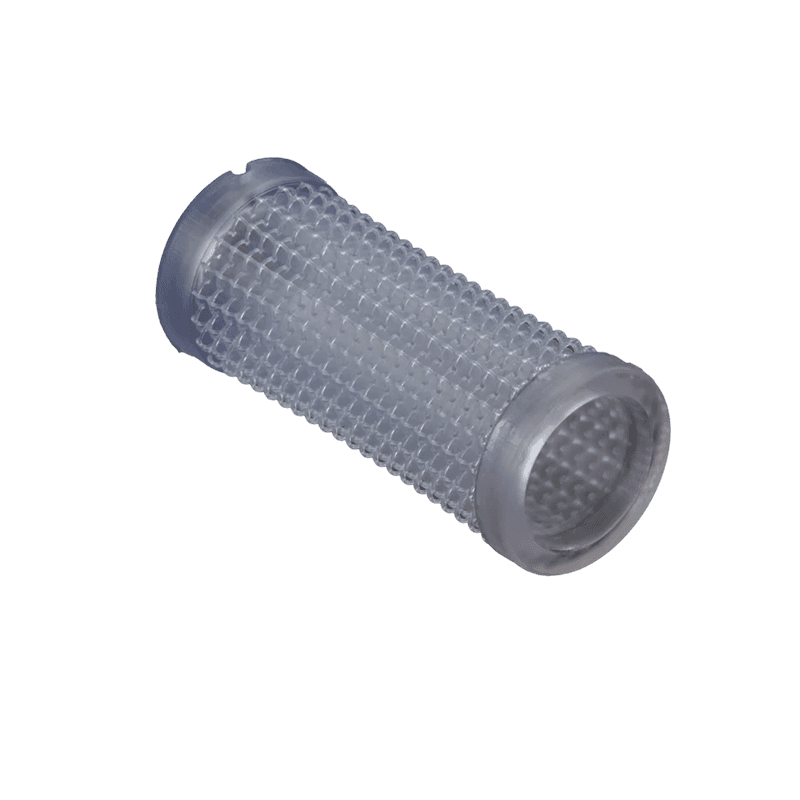

Compare materials side by side.
Pick any two or three and weigh them attribute by attribute. Share the link to send it to a teammate.
The easiest filament to print — stiff, cheap, low heat tolerance.
A tougher, more heat- and chemical-resistant step up from PLA.
Popular material comparisons.
The head-to-heads people search for most — each with an honest verdict and a clear recommendation.
Filament head-to-heads
The FDM filaments people compare most — and where to go when you outgrow them.
Process & resin vs. filament
How the big processes stack up, including the two Form Now runs in-house.
SLA vs SLS
Both printed by Form Now — detail and finish versus functional strength.
Not sure which to choose?
Tell us what you're making and what matters most — we'll rank every process and recommend a material to print it in.
SLS
Selective Laser SinteringStrong, support-free nylon parts for real-world use.
FDM
Fused Deposition ModelingThe most accessible way to print large, low-cost parts.
Two technologies, printed in-house.
Form Now runs industrial SLA and SLS for you — resin for detail and finish, nylon for functional strength.
SLA
StereolithographyA laser cures liquid resin layer by layer for the smoothest surfaces and finest detail — ideal for crisp prototypes, master patterns, and presentation models across rigid, tough, flexible, and castable resins.
Print in SLASLS
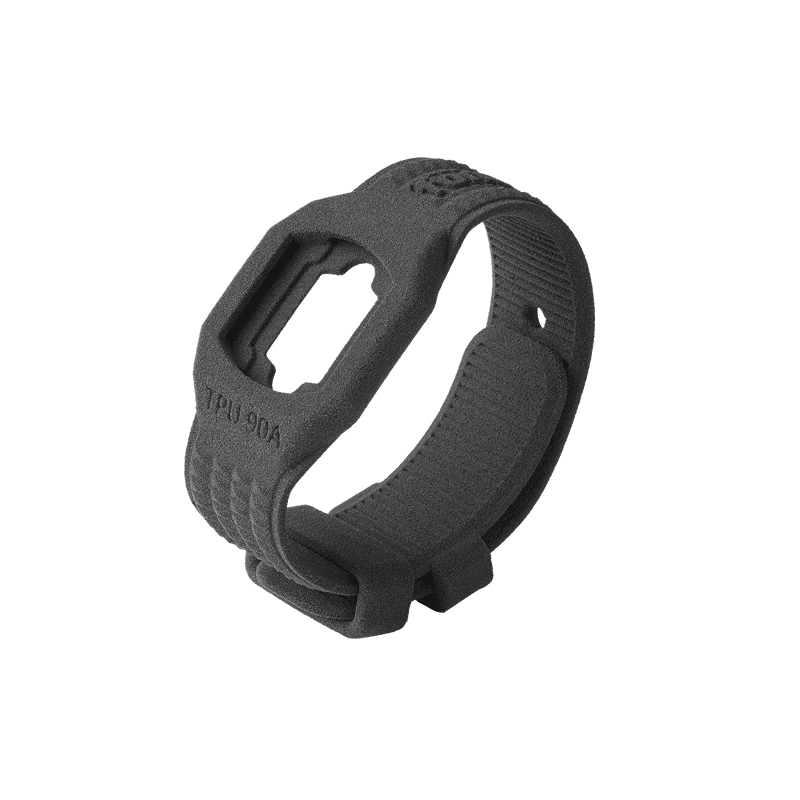
Selective Laser SinteringA laser fuses nylon powder into strong, support-free functional parts — the workhorse for end-use components, complex assemblies, and durable prototypes in Nylon 11, Nylon 12, glass-filled nylon, and TPU.
Print in SLSExplore the Form Now material catalog.
Every SLA resin and SLS nylon we print — real specs, datasheets, and finishes. Tap any material for the full details.
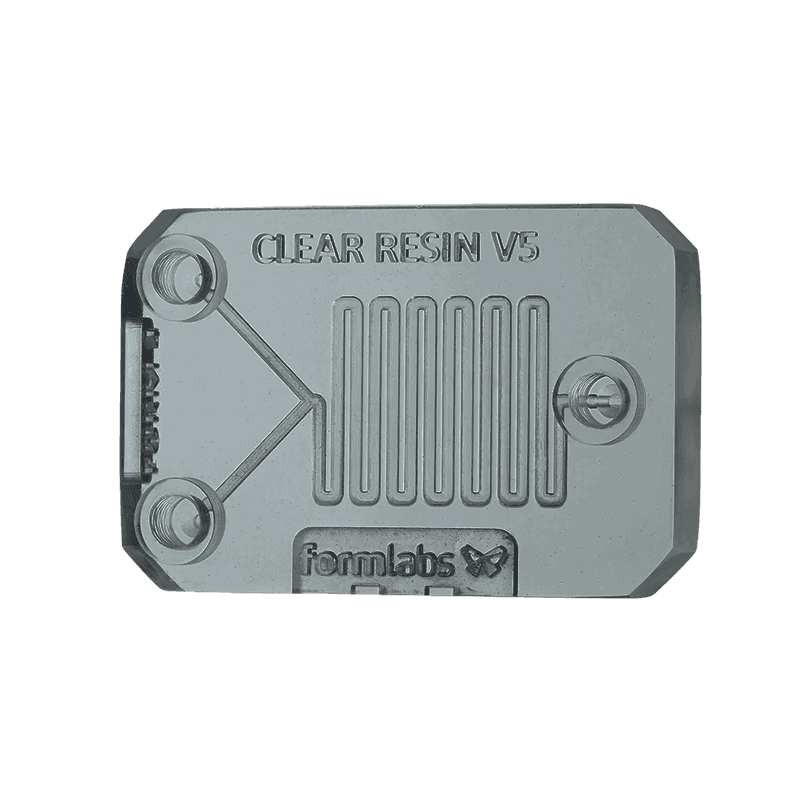
Clear Resin
Optically clear (~85% transmittance) for fluidics and light pipes.
- Notched Izod
- 29 J/m
- Tensile Modulus
- 2.75 GPa
Tough 2000 Resin
Strongest, stiffest Tough resin — ABS-like for rugged prototypes.
- Notched Izod
- 25 J/m
- Tensile Modulus
- 1.8 GPa
Nylon 12
Versatile, balanced, biocompatible — the go-to functional powder. Also in white.
- Notched Izod
- 32 J/m
- Tensile Modulus
- 1.9 GPa
Smooth, detailed resin parts on the Form 4 — 12 resins across general, tough, rigid, flexible, and specialty.
General purpose
Tough & durable
Rigid
Flexible & elastomeric
Specialty
Nylons & elastomers
Material questions, answered.
Glass-filled nylon, carbon fiber, castable resin, tolerances and more — what they mean and where Form Now fits.
Glass-filled nylon blends short glass fibers into a nylon matrix to raise stiffness, dimensional stability, and heat deflection well above unfilled nylon, at the cost of some ductility and a slightly rougher surface. It is the go-to for jigs, fixtures, brackets, and housings that must hold their shape under load and elevated temperature. In SLS, glass reinforcement also reduces warping on flat, large-area parts. Compared with FDM nylon, an SLS glass-filled part is isotropic, so it has no weak layer-line direction, and it needs no support structures, freeing up complex geometry. Form Now prints this in-house as Nylon 12 GF (glass-filled), so you get production-grade stiffness and heat resistance without running it yourself. If you are weighing it against unfilled SLS Nylon 12 (tougher, more flexible) or stiffer Rigid 10K resin, upload your part for a quote and we will recommend the right grade.
Get a quoteTolerance is how closely a printed feature matches its nominal dimension, and it varies sharply by process. Desktop FDM typically holds roughly plus or minus 0.3 to 0.5 mm and is constrained by nozzle width, layer height, and warping on large flats. SLA resin printing is far tighter, commonly plus or minus 0.1 to 0.2 mm with crisp, smooth features, because it cures fine layers from liquid rather than extruding a bead. Industrial SLS sits near plus or minus 0.3 mm but is isotropic and support-free, which keeps complex geometry accurate in every direction. Wall thickness, feature size, and orientation all shift achievable tolerance. Form Now prints both SLA (Standard Resin V5 for fine detail, Rigid 10K for stiff accuracy) and SLS Nylon 12 in-house, so you can match the tightness your part demands. Share your model and target tolerances for a quote and a process recommendation.
Get a quoteCarbon-fiber 3D printing chops carbon fibers into a polymer (often nylon) to deliver high stiffness-to-weight, good heat resistance, and a rigid, low-creep part. It is popular for lightweight brackets, drone frames, and tooling. The fibers mainly boost modulus and dimensional stability; they do not make a part indestructible, and chopped-fiber FDM still carries layer-line anisotropy. Form Now does not print carbon-fiber-filled material and does not run FDM, so we will be straight with you here. If your real requirement is stiffness, heat resistance, and dimensional stability rather than literal carbon fiber, Form Now prints two honest in-house alternatives: glass-filled Nylon 12 GF, which is isotropic and support-free with strong heat performance, and Rigid 10K resin, a glass-reinforced resin for very stiff, detailed parts. Neither is carbon fiber, but both target the same engineering goals. Send your part for a quote and we will advise which fits.
Carbon-fiber nylon combines a tough nylon base with chopped carbon fiber to gain rigidity, heat resistance, and dimensional stability while staying lighter than metal. It suits structural brackets, fixtures, and end-use tooling. The fiber raises stiffness and lowers warping, but in FDM the part still has anisotropic layer lines, and abrasive fiber wears nozzles. Form Now does not print carbon-fiber nylon and does not run FDM, so we will not pretend otherwise. When the goal is a stiff, heat-resistant, dimensionally stable nylon part rather than carbon specifically, the honest in-house match is glass-filled Nylon 12 GF. As an SLS material it is isotropic and support-free, so there is no weak build direction, and the glass reinforcement adds the stiffness and heat resistance you were chasing with carbon fiber. It is glass-filled, not carbon, but it serves the same structural intent. Upload your model for a quote and a fit recommendation.
Castable resins are specialty SLA resins formulated for the lost-wax investment casting workflow used in jewelry and dental restorations. They print crisp masters, then burn out cleanly in the kiln with minimal ash and no expansion that would crack the investment, leaving a clean cavity for molten metal. The two things that matter most are detail fidelity (sharp prongs, filigree, crown margins) and a controlled, residue-free burnout, which is why these resins carry high wax content. Form Now does not currently offer a dedicated castable resin, so it is not the right fit if your end goal is investment casting directly from the print. Where Form Now genuinely helps is the front half of the problem: SLA holds extremely fine features and a smooth surface, so Standard Resin V5 is excellent for high-detail concept models, fit checks, and master patterns for silicone molding, while Rigid 10K suits stiff, dimensionally stable masters. For true burnout casting, source a purpose-built castable resin.
Food-safe 3D printing is more nuanced than picking a single material. A part that contacts food has to satisfy several independent concerns: the polymer and any colorants must be food-contact approved, the printing process must not introduce uncured monomers or additives, and the surface itself matters. FDM layer lines and print porosity trap bacteria and resist cleaning, so even an otherwise compliant material can fail in practice. Reusable food-contact parts usually require a certified food-safe sealing coat, or more reliably, using the printed part only as a mold for a food-grade material. Dishwasher heat, repeated washing, and abrasion all degrade coatings over time. Form Now does not currently offer a certified food-safe material, and no Form Now part should be treated as food-safe without independent, application-specific validation by you or a qualified lab. Treat any food-contact use as case-by-case: confirm the specific resin or nylon datasheet, the regulatory standard you must meet, and your cleaning and post-processing plan before relying on a printed part.
Polycarbonate (PC) is an FDM filament prized for high heat deflection (often well above 110C), strong impact resistance, and good stiffness, which makes it a go-to for jigs, housings, and parts near heat sources. The tradeoffs are real: PC is hygroscopic and demands a hot, enclosed, well-dried printer, and like all FDM parts it is anisotropic, so layer adhesion is the weak axis under load. Form Now does not run FDM and does not print polycarbonate, so it cannot supply PC itself. If what you actually need is the engineering profile rather than the polymer name, Form Now offers honest alternatives it prints in-house. Rigid 10K is a glass-filled SLA resin delivering very high stiffness, a high heat-deflection temperature, and excellent dimensional stability for fixtures and brackets. Glass-filled Nylon 12 GF (SLS) adds stiffness and elevated heat resistance with isotropic strength, avoiding FDM layer-line weakness. Neither is polycarbonate, but for stiffness-plus-heat duty they are strong substitutes. Send your part for a quote.
For miniatures, tabletop figures, and other small high-detail models, SLA resin printing is the clear winner. Because the laser cures fine features directly, resin captures sharp edges, crisp facial detail, fabric folds, and thin elements far better than extrusion printing, and the surface comes out smooth with no visible layer banding to sand away. The best resins for this work balance fine resolution against enough toughness to survive handling and cleanup of delicate parts. Form Now prints Standard Resin V5, an SLA material built for exactly this kind of high-detail, smooth-finish output, making it a strong fit for display miniatures, master patterns, and presentation models. If your minis need to flex or take repeated drops, a tougher resin trades a little crispness for durability, so match the resin to whether the piece is for display or play. Upload your model to Form Now for a quote on Standard Resin V5.
Get a quoteFDM, SLA & SLS — how each process works.
What each technology is, how it works, and the jobs it does best.
SLA — Stereolithography
Prints at Form NowSmooth, precise resin parts with the finest detail.
Stereolithography (SLA) is a resin 3D printing process that uses a laser to cure liquid photopolymer layer by layer. It delivers the smoothest surface finish and the finest feature detail of any common technology, making it the go-to choice for crisp prototypes, master patterns, and intricate models.
How it works
A UV laser traces each layer onto the surface of a tank of liquid resin, selectively hardening it. The build platform lifts a fraction of a millimeter and the next layer cures onto the last, producing dense, isotropic parts that are washed and UV post-cured.
Best for
- Concept & visual models
- Functional prototypes
- Casting patterns & molds
- Flexible & rubber-like parts
- High-heat & engineering parts
Example materials
- Grey / Black / White / Clear Resin V5
- Tough 1500 & Tough 1000
- Rigid 10K
- Elastic 50A & Flexible 80A
Strengths
- Best-in-class surface finish and fine detail
- Tight tolerances and high dimensional accuracy
- Huge material range — rigid, tough, flexible, castable, high-temp
Trade-offs
- Resins can be more brittle than thermoplastics
- Supports needed for overhangs
- Some resins degrade under prolonged UV / outdoor exposure
SLS — Selective Laser Sintering
Prints at Form NowStrong, support-free nylon parts for real-world use.
Selective Laser Sintering (SLS) fuses nylon powder with a laser to build durable, functional parts. Because un-sintered powder supports the part, SLS handles complex geometries, interlocking assemblies, and living hinges without support structures — the workhorse process for end-use parts.
How it works
A laser sinters fine polymer powder one layer at a time inside a heated build chamber. The surrounding loose powder acts as built-in support, so designs with internal channels, snap-fits, and moving parts print in a single job and are simply cleaned of excess powder afterward.
Best for
- Functional prototypes
- End-use & production parts
- Jigs, fixtures & tooling
- Flexible & rubber-like parts
- Large parts
Example materials
- Nylon 12 & Nylon 11
- Nylon 12 GF (glass-filled)
- Nylon 12 White
- TPU 90A (flexible)
Strengths
- Strong, durable, isotropic functional parts
- No support structures — complex and nested geometries print freely
- Great for small-batch production and robust prototypes
Trade-offs
- Grainy, matte surface straight off the printer
- Limited to a nylon / TPU material family
- Not transparent; colors are dyed rather than native
FDM — Fused Deposition Modeling
The most accessible way to print large, low-cost parts.
Fused Deposition Modeling (FDM), also called FFF, extrudes melted thermoplastic filament along a path to build a part layer by layer. It is the most widely available and lowest-cost 3D printing process, ideal for early concept parts, large fixtures, and budget-conscious prototyping.
How it works
A heated nozzle melts thermoplastic filament and deposits it in beads that fuse as they cool. Parts build up in stacked layers, with breakaway or dissolvable supports for overhangs. Layer lines are visible and bonding between layers makes parts weaker along the Z axis.
Best for
- Concept & visual models
- Jigs, fixtures & tooling
- Large parts
Example materials
- PLA
- ABS
- PETG
- Nylon
- Polycarbonate
Strengths
- Lowest cost and most accessible technology
- Wide range of common thermoplastics
- Good for large, simple parts and quick concept checks
Trade-offs
- Visible layer lines and rougher surface
- Anisotropic — weaker between layers
- Lower detail and accuracy than resin or powder processes
Frequently asked questions.
Start with what you are making and what matters most — surface finish, strength, flexibility, heat resistance, cost, speed, or accuracy. FDM filaments like PLA, PETG, and ABS are the most affordable and the easiest to print on a desktop. SLA resin wins on fine detail and a smooth finish. SLS nylon wins on isotropic strength and functional durability with no supports. The selector above ranks options against your specific priorities.
SLA (stereolithography) cures liquid resin with a laser to produce smooth, highly detailed, accurate parts — ideal for visual models, master patterns, and crisp prototypes. SLS (selective laser sintering) fuses nylon powder into strong, durable functional parts and needs no support structures, making it the better choice for end-use components and complex assemblies. Form Now offers both.
For everyday filaments, polycarbonate and nylon are the toughest FDM options. For genuinely strong, direction-independent parts, SLS nylon is the standout: it is isotropic, so it avoids the layer-line weakness of FDM, and glass-filled Nylon 12 GF adds stiffness and heat resistance. On the resin side, Form Now's Tough and Rigid resins give strong, accurate parts with a smooth finish.
SLA resin delivers the smoothest surface and the finest detail, approaching injection-molded quality straight off the printer. SLS nylon has a fine matte, slightly grainy finish, while FDM shows visible layer lines. If appearance and crisp features matter most, SLA resin is the clear choice.
Cost depends on the process, material, part size, and quantity. Desktop FDM filament is the most economical for simple parts, while SLA resin and SLS nylon are competitively priced for professional-quality prototypes and end-use parts. Form Now gives you an instant, transparent quote the moment you upload a model — no sales call required.
Form Now prints in industrial SLA and SLS — it does not print FDM filaments like PLA, PETG, or ABS. Across its SLA resins and SLS nylons (28+ materials, from Standard and Clear resins to Tough, Rigid, Elastic, and Nylon powders), you can upload a model for an instant quote, choose a material and finish, and we print, post-process, and ship professional parts, often in as little as two days.
Found your process? Form Now can print it for you.
Upload your model for an instant quote across 28+ industrial SLA & SLS materials. We print, post-process, and ship professional parts — often in as little as two days.