TPU 90A Powder (SLS)
A tough sintered elastomer with high elongation at break and superior tear strength, for flexible, resilient, skin-safe parts. TPU 90A prints lattices and complex flexible geometry that no support structure could ever be removed from.
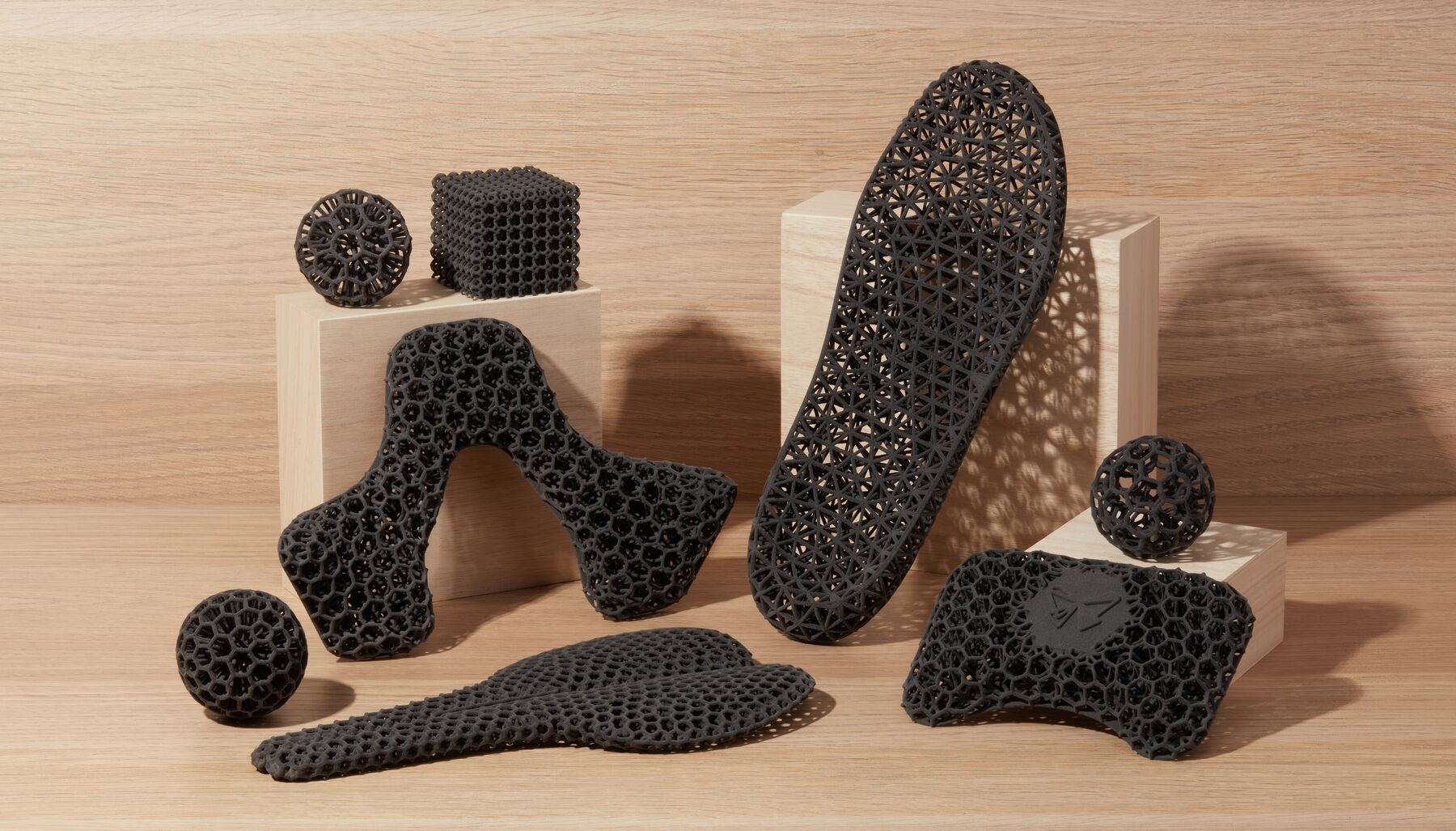
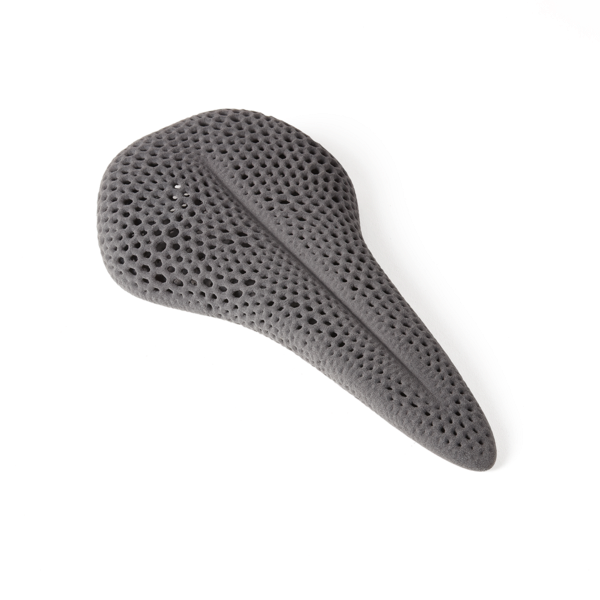
Real TPU 90A SLS Parts
Actual Formlabs SLS prints in TPU 90A Powder, not renders.

Summary & Key Takeaways
- Stretches Further Than Anything Else We Print: 310% elongation at break, well past both flexible resins.
- Lattices Without Supports: Powder-bed sintering prints flexible lattices and internal channels that could never be de-supported in SLA.
- Skin Safe: Rated biocompatible on its technical data sheet, which suits orthotics and footwear.
- Firm, Not Soft: At 90A Shore it is the firmest elastomer we print; choose Flexible 50A when the part must be squeezable.
Compare TPU 90A SLS to Other 3D Printing Materials
A quick, scannable comparison against the other flexible materials we print. All values are shown at once; use the buttons to focus on one comparison at a time.
Swipe to see all materials →
| Property | TPU 90A SLS | Flexible 80A V2 | Flexible 50A |
|---|---|---|---|
| Shore hardness | 90A | 83A | 55A |
| Tensile strength | 8.7 MPa | 10 MPa | 3.4 MPa |
| Elongation at break | 310% | 230% | 160% |
| Support structures | None required | Removable supports for overhangs | Removable supports for overhangs |
Why Choose TPU 90A Powder (SLS)?
The only flexible material we print that needs no supports, which changes what geometry is possible.
Flexible Lattices, No Supports
Sintering in a powder bed means midsoles, cushioning lattices, and internal flexible channels print with nothing to remove afterwards, geometry that is effectively impossible in a support-dependent process.
Stretches and Recovers
310% elongation at break with superior tear strength lets straps, boots, and protective parts absorb repeated stretching and everyday abuse without a tear propagating from an edge or hole.
Skin Safe for Worn Parts
TPU 90A is rated biocompatible on its technical data sheet, and at 90A Shore hardness it has the firm, resilient feel that orthotics, insoles, and shoe soles need to support load.
TPU 90A SLS Design Rules (DFM) at a Glance
Formlabs SLS design guidelines for the Fuse Series, adjusted for sintered elastomers. Check your CAD feature dimensions against these limits before uploading your file.
| Min. wall thickness (vertical · horizontal) |
1.0 mm for both (held above the sintered-nylon minimum so flexible walls survive depowdering) |
|---|---|
| Min. pin/wire diameter | 0.8 mm |
| Min. hole diameter | 1.0 mm |
| Min. drain/escape hole (2 per powder-trapping cavity) | 3.5 mm |
| Clearance, mating features separated after printing | 0.2 mm (< 20 mm²) · 0.4 mm (> 20 mm²) |
| Clearance, mating features printed pre-assembled | 0.3 mm (< 20 mm²) · 0.6 mm (> 20 mm²) |
| Clearance between unrelated parts in a build | 1.0 mm min · 5.0 mm recommended |
| Min. embossed detail (raised text/logos) |
0.15 mm deep, horizontal face · 0.35 mm deep, vertical face (4.5 mm min. text height) |
| Min. engraved detail (recessed text/logos) |
0.1 mm deep, horizontal face · 0.15 mm deep, vertical face (3.0 mm min. text height) |
| Dimensional tolerance (XY) | Looser than the ±0.5% or ±0.3 mm our sintered nylons hold; leave extra clearance on fits |
| Max. single-part build size | 165 × 165 × 300 mm |
Source: Formlabs' Design specifications for 3D models: Fuse 1, adapted to hold walls to a higher minimum than Formlabs' published figures. TPU 90A is a sintered elastomer, so it is held to a higher minimum wall than our sintered nylons: flexible thin walls distort during depowdering and media blasting where a rigid nylon wall of the same thickness would survive. These are general guidelines; thicker cross-sections, hole depth, and part geometry can shift the safe minimums for a specific design. Maximum build size reflects the SLS printers currently qualified for TPU 90A; actual build size depends on which machine your order routes to. Formlabs publishes no dimensional tolerance for TPU 90A and rates it below the nylons for accuracy; the nylon figure quoted for comparison is Formlabs' published typical XY tolerance for Fuse Series SLS.
Frequently Asked Questions
Everything you need to know about designing, ordering, and using TPU 90A SLS parts on Form Now.